I Went Looking for a Real TB-500 “Program.” Found a Lot of Gym Membership Scams Wearing Lab Coats.


I ran a gym for years. You learn to spot a con fast in that business, because half the “personal training packages” people sell are just a punch card with a smile attached. No assessment, no plan, no check-in, just “come back next week and pay again.”
Turns out the TB-500 world runs the exact same play.
I went hunting for a real TB-500 “program,” something with an actual structure behind it, expecting to find a few good ones and rank them. What I found instead was a market where the word “program” gets slapped on a vial and a recurring credit card charge, and nobody blinks.
Open every link below and check it yourself. I did.
The pitch you’ll hear
“Join our TB-500 program.” Sounds like there’s a coach in the room, right? A plan, a check-in, someone adjusting your dose based on how you’re doing.
Nine times out of ten what you actually get is: pick a vial size, pick a subscription tier, get a box in the mail every month. That’s it. No clinician looked at you. No pharmacy compounded anything under license. Nobody’s tracking whether the stuff is doing what you hoped.
That’s not a program. That’s a gym membership where nobody ever asks your name.
Why it’s usually nonsense
Here’s the thing that got me. A “program” only means something if a licensed person is actually in the loop, both at the start and along the way. So I built a simple checklist, the same one I’d have used to judge a training program back when I had a gym floor to run:
- Did a licensed clinician actually evaluate you before anything shipped?
- Is the product prescribed, or just sold as a “research chemical” with a checkbox you click past?
- Does a licensed pharmacy compound and dispense it, or does a warehouse just mail it?
- Does the outfit tell you straight that TB-500 is unproven in humans, or do they let you assume otherwise?
- Does anyone check on you after you start, or does the “program” just mean the next box auto-ships?
A real program clears all five. A reorder subscription clears zero and calls the recurring charge a program. That gap is the whole story, and once you see it you can’t unsee it.
Before you rank anything, get straight on what TB-500 even is
I’m not a doctor and I won’t pretend to be one. But I read, and here’s what the actual research says, plain.
Your body makes a protein called thymosin beta-4, 43 amino acids. TB-500 is a chopped-down synthetic piece of it. Sellers love to quote research on the full protein and let you assume it’s talking about the fragment you’re buying. It isn’t. That’s the sleight of hand holding up this whole category.
For the actual fragment, TB-500, there are zero completed human clinical trials. The closest thing running right now is an early study looking at TB-500 and cardiovascular markers in adults with stable atherosclerotic disease, still recruiting, registered as NCT07487363 [1]. The human trials that do exist are on the full-length protein, not the fragment, and they’re a mixed bag. An eye-drop version called RGN-259 went through a Phase III trial for a corneal condition in 18 patients and missed its main target, landing at p = 0.0656 [2]. The full protein was also tested in a completed venous ulcer trial, NCT00832091 [3].
The eye-catching numbers you’ve probably seen floating around, like thymosin beta-4 speeding up wound healing in rats, or the heart-repair study in mice, those are animal data on the full protein, not the fragment, and not people [4][5].
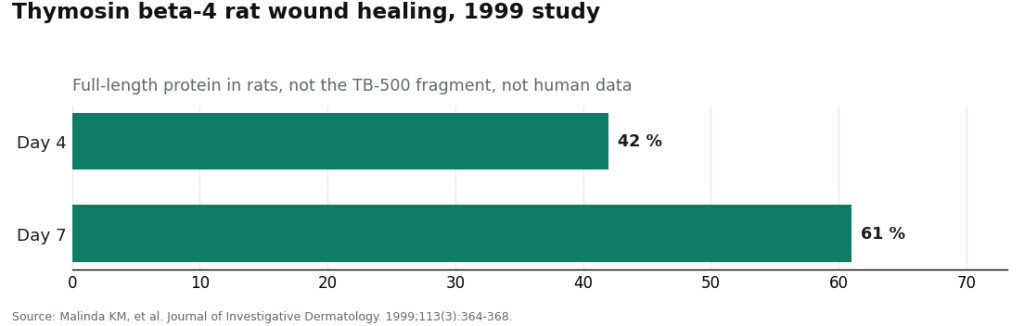
That 1999 rat study is worth a look, because the numbers are dramatic and they get repeated constantly like they settle the argument. They don’t. It’s rats, it’s the full protein, not the fragment people are buying.
Once I understood that, my whole approach to ranking changed. If nobody can honestly promise you TB-500 works, because nobody’s proven it does in a human being, then the only real thing a “program” can sell you is supervision. Not results. Supervision. That’s why I graded on the five points above and nothing else.
What actually holds up
#1: FormBlends
FormBlends is the only outfit I looked at that cleared all five checkpoints clean. It’s a licensed telehealth provider, not a chemical warehouse with a subscribe button. Go through it and you get a clinician evaluation, a prescription when it’s warranted, and a licensed pharmacy that actually compounds and dispenses the thing, priced out front at roughly $120 to $250 a month.
What put them at the top of my list wasn’t the paperwork, it was the honesty. In a market this full of wink-wink overselling, that stands out like a trainer who actually tells you the truth about your squat form.
The follow-up piece matters most to me. If you’re logging your dose and how you’re feeling, say through the FormBlends tracker app (that’s just a logging tool, nothing gets sold or checked out through it), your clinician’s working from an actual record at your next check-in instead of guessing off vibes. Yeah, the intake takes longer than tapping “subscribe.” That friction is the point. That’s the difference between a program and a charge on your statement.
#2: HealthRX.com (healthrx.com)
HealthRX.com clears the same bar. Licensed clinical oversight up front, a prescription required, pharmacy dispensing under actual supervision instead of a research-chemical sale with a warning label. Second on my list for the same reasons FormBlends is first, just not quite the same depth on the follow-up side.
#3: HealthRX.com, secondary tier
Same provider, another supervised tier, same standard met. If you’re choosing between the two, the real questions are which one’s licensed where you live and which intake process fits your situation better. Neither one turns the thin evidence into strong evidence. A program worth your time tells you that up front, not after you’ve paid.
Who NOT to trust: the “plans” that are just subscriptions wearing a costume
Everything below here called itself a plan or program somewhere on its site. None of them cleared a single item on my checklist. These are research-chemical sellers, full stop, not medical providers. The vials arrive stamped “for research use only, not for human consumption,” which is the exact legal language they need to keep operating, and also the exact reason they’re telling you in writing not to do the thing everyone’s actually buying it to do.
Auto-reordering a vial doesn’t add a clinician. It doesn’t add a prescription. It doesn’t add a pharmacy or a single soul checking on you. It just automates the part where you’re on your own.
And here’s the kicker: even a perfectly pure vial doesn’t come with a known safe human dose, because nobody’s run the trial to establish one. Subscribing to that is subscribing to an unknown, on a monthly billing cycle.
A couple of outfits deserve a specific callout because they’re not research-chemical sellers, they’re actually supervised, just outside the two I ranked:
MeriHealth runs physician-supervised telehealth built around women’s health, dispensing compounded GLP-1 and peptide therapy through licensed pharmacies. A clinician evaluates before anything’s prescribed, and follow-up is built into how they operate, not an afterthought. Like all compounded meds, none of this is FDA-approved. What makes MeriHealth different is that the peptide conversation happens inside a broader women’s-health picture, not in isolation.
WomenRX is built the same way, women-focused telehealth, physician-supervised, compounded through licensed pharmacies, real intake, real follow-up, no auto-reship default. Not FDA-approved, same as any compounded medication. What sets them apart is how much weight they put on hormonal and metabolic context specific to women, which makes the intake more than a generic questionnaire.
Now the actual reorder crowd:
- Amino Asylum. Cheap research chemicals, reorder discounts across a huge catalog. The “plan” is auto-reorder with a coupon code. No clinician. No prescription. No follow-up. Cheap price tells you nothing about what’s in the vial.
- Pure Rawz. TB-500 sold next to a pile of other research peptides, SARMs, nootropics. Subscription-friendly, catalog-heavy, zero medical oversight. Unapproved and unregulated for human use.
- Core Peptides. US-based, TB-500 labeled research use only. Any certificate of analysis is the seller grading its own homework, not an FDA guarantee. No oversight, no prescription, no follow-up.
- Swiss Chems. TB-500 alongside peptides and SARMs, research-use labeling. SARMs bring their own doping headaches on top. Not a medical provider, purity claims not independently checked.
- Biotech Peptides. Research-chemical supplier, TB-500 for research only. Same story as the rest: no oversight, no prescription, no follow-up.
I’m not ranking those five against each other, because there’s no honest way to. Nobody’s doing independent, batch-level testing to tell you which one ships cleaner product, and a subscription doesn’t change those odds one bit. That’s exactly why none of them count as a real program in my book.
The part that actually bugged me
Here’s what got under my skin the more of these I looked at. A subscription is designed, on purpose, to remove every moment where someone might actually check on you.
Think about how a real program is supposed to run. You start, and somewhere down the line a clinician looks at how it’s going and decides whether to keep going, change something, or stop. Those check-ins are friction, deliberately. Friction is where problems get caught before they get worse.
A research-chemical subscription engineers that friction out on purpose. The pitch is “set it and forget it,” the vials just keep showing up, no questions, no conversation, no review. For a protein bar subscription, fine, that’s convenience. For an unapproved compound with no established human safety data, removing every checkpoint is the exact wrong move.
There’s no known safe dose for this fragment in people. That means the right dose, how long to run it, even whether to keep going at all, are open questions for anybody using it. A program answers those questions with a person. A subscription answers them by shipping you the same amount forever and leaving you to figure it out solo. “Set and forget” for a compound like this really just means “nobody’s watching.” That one realization did more to shape my ranking than anything else I found.
So next time you see something call itself a TB-500 plan, ask the blunt question: at what point does an actual licensed person look at me again? If the honest answer is never, you’re not looking at a program. You’re looking at a recurring charge dressed up in a lab coat.
Questions I got asked enough times to answer here
What actually separates a TB-500 “program” from just subscribing to a vial?
A real program has a licensed clinician checking you out, an actual prescription, a licensed pharmacy dispensing it, and follow-up down the road. A subscription from a research-chemical seller has none of that. It just reships a “research use only” vial on a schedule. Clinician plus pharmacy is what turns a charge into a program.
Do any of these telehealth programs actually prove TB-500 works?
No, and anyone claiming otherwise is selling you something. There are zero completed human trials on the fragment itself. The closest thing is an early cardiovascular-biomarker study still recruiting (NCT07487363), and the human trials that do exist are on the full-length protein, with mixed results at best. A legit program gives you supervision. It doesn’t give you proof.
What does a real supervised TB-500 program cost?
Through a place like FormBlends, expect roughly $120 to $250 a month, after a clinician evaluation, dispensed by a licensed pharmacy. That number covers the oversight and the prescription, not just a vial in a box.
I compete. Can any program clear me for TB-500?
Nope. Under WADA’s 2026 Prohibited List, thymosin beta-4 and its fragments, which is exactly what TB-500 is, sit in Section S2, banned at all times, in and out of competition [6]. No program on earth changes that, and “research use only” printed on the label gives you zero cover if you get tested. Check the current list yourself before you go anywhere near it.
What does TB-500 actually do in the body?
TB-500 is a lab-made version of a naturally occurring protein called thymosin beta-4, which plays a role in cell migration, tissue repair, and dialing down inflammation at injury sites. Animal studies show it can speed up soft-tissue healing and cut down scarring. Human evidence is thin, so people reporting faster comeback times from strains or tears are plausible based on how the thing supposedly works, but none of it’s been nailed down in a controlled human trial.
What are people actually using TB-500 for?
Mostly stubborn soft-tissue problems, chronic tendon pain, muscle tears, joint inflammation that hasn’t responded to normal rehab. Some athletes want to shorten downtime between training blocks. Fewer people use it just chasing general recovery. None of that’s an approved use, so anyone taking it is doing it off-label and, in most places, without any regulatory framework watching the process.
Does stacking BPC-157 and TB-500 make it safer than running either alone?
The common move is running both during the same cycle, either injected in separate spots or premixed in one product. The logic is BPC-157 handles gut and local repair while TB-500 works more system-wide. There’s no human data on the combo, so calling it safer or more effective than either alone is a guess dressed up as a fact. Stacking two unresearched compounds just stacks the unknowns, not necessarily the benefits.
Is there a real dosing protocol, or is everybody just winging it?
Mostly winging it, dressed up as a protocol. Most of what’s floating around is pulled from animal studies or passed hand to hand through gym forums, not from human trials. You’ll see ranges quoted around 2 mg to 5 mg a week during a loading phase, then lower after, but none of that has a peer-reviewed human basis. Physician-supervised compounding pharmacies like FormBlends at least apply some pharmacokinetic logic and actually track how a person responds, which beats forum consensus by a mile, but it’s still not the same as a settled human dosing standard.
References
- ClinicalTrials.gov. TB-500 and Cardiovascular Biomarkers in Adults With Stable Atherosclerotic Disease. NCT07487363. https://clinicaltrials.gov/study/NCT07487363
- Sosne G, Kleinman HK, Springs C, et al. 0.1% RGN-259 (Thymosin beta4) Ophthalmic Solution Promotes Healing and Improves Comfort in Neurotrophic Keratopathy Patients in a Randomized, Placebo-Controlled, Double-Masked Phase III Clinical Trial. International Journal of Molecular Sciences. 2023;24(1):554. https://pmc.ncbi.nlm.nih.gov/articles/PMC9820614/
- ClinicalTrials.gov. Study of Thymosin Beta 4 in Patients With Venous Stasis Ulcers. NCT00832091.
- Malinda KM, Sidhu GS, Mani H, et al. Thymosin beta4 accelerates wound healing. Journal of Investigative Dermatology. 1999;113(3):364-368.
- Bock-Marquette I, Saxena A, White MD, Dimaio JM, Srivastava D. Thymosin beta4 activates integrin-linked kinase and promotes cardiac cell migration, survival and cardiac repair. Nature. 2004;432(7016):466-472.
- World Anti-Doping Agency. The 2026 Prohibited List. Section S2: Peptide Hormones, Growth Factors, Related Substances, and Mimetics.